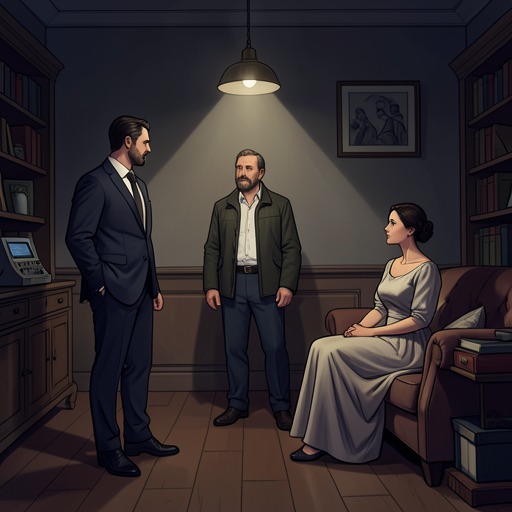
Clifford Sorenson
A Killer’s MindClifford Sorenson is a West Pullman plumber whose fiancé, Veronika Murray, was murdered after disappearing from their home. His fishing-trip alibi initially separated him from the case’s main suspicion, but Zoe Bentley’s later investigation exposed a troubling connection between his plumbing business, his brother Jeffrey Alston, and another woman linked to the murders. Clifford’s role turns on that shift: first a bereaved fiancé whose account is filtered through police suspicion, then a witness who confirms a fact that urgently redirects the investigation.
Identity and Background
Clifford ran Sorenson’s Plumbing in West Pullman. The business occupied a warehouse-like building, with a small sign above the entrance and its logo on two blue vans parked outside. His brother Jeffrey worked there as an employee. A neighbor later identified Clifford as a plumber and recalled that, as a boy, his mother had called him Cliff, a small personal detail that helped Zoe connect the business and the man she was seeking.
Clifford had been engaged to Veronika. In the weeks before her disappearance, she seemed tense; the police report recorded that observation, but investigators did not pursue it beyond questions about whether strain in the relationship might explain it. Clifford later told Zoe that he believed Veronika was afraid and angry about his continuing to go fishing and leaving her alone in the evenings. He could not say that she had stated this directly: his account was an interpretation of her agitation and of a remark she had once made about people inheriting traits from their families.
Veronika’s Disappearance and the Alibi
Clifford told Zoe that he had last seen Veronika on the morning she died, before he went to work. When he returned, she was visiting a friend. That friend confirmed that Veronika had eaten dinner with her, and her account placed Veronika away from home before Clifford left on his fishing trip with three friends.
Clifford returned sometime after midnight. He found the house in disarray: the table and chairs had been overturned, closets and drawers stood open, and Veronika and her jewelry were missing. One of the fishing companions had gone inside the house with him during the return, because he needed to use the bathroom. The friends verified that Clifford had been with them during the relevant period, and the police treated the trip as his alibi.
The alibi did not make the loss less immediate. When Zoe asked about the night, Clifford recalled the disturbance and disappearance, then asked to be excused. His account was composed in its details, but the interruption suggested how difficult that week remained for him more than two years later. He told Zoe he had been working hard to forget it.
Interviews and Investigative Doubt
Police questioned Clifford three times, and Zoe read the transcripts before meeting him. The first interview was chiefly intended to establish whether he was a suspect. The second followed the arrest of a drug dealer: officers showed Clifford photographs in the hope that he might recognize the man, but he said he did not recognize anyone. After police abandoned that suspect, a third interview focused on probing Clifford’s alibi. He became angry, accused the officers of trying to frame him, and demanded an attorney; the interview soon ended without resolving the matter.
Zoe noticed that the interviews followed the investigators’ changing theories. In the first, Clifford’s report that Veronika had seemed on edge led to questions about possible relationship problems, but no one returned to the subject afterward. The detail therefore remained in the record without being fully explored. Zoe approached Clifford with the transcripts and asked about that overlooked anxiety, not simply to test his alibi but to understand what the original questioning had left aside.
At the time of their meeting, Clifford said he could try to answer but could not promise to remember the week clearly. He had last seen Veronika in the morning, and he remembered returning to the disordered house after midnight. The gap between those recollections and the police’s narrowed questions becomes important to Zoe’s method: an alibi can establish where a person was, while still leaving other relationships and circumstances unexplained.
The Brother’s Connection
Later, Zoe returned to Sorenson’s Plumbing and found only Jeffrey Alston at the business. In a subsequent conversation, Clifford supplied the context for Veronika’s unease: she had been angry that he kept going fishing and leaving her alone at night, and he thought she had been afraid. Her remark about people not falling far from the family tree acquired added weight once Zoe suspected that the case might involve someone close to Clifford, though the words alone did not establish who was responsible.
When Zoe and Tatum Gray confronted him, she told Clifford they had reason to believe his brother had killed Veronika. Clifford’s immediate response was to pick up the desk phone and say he would call his lawyer, then his brother, so Jeffrey could speak to a lawyer as well. Zoe pressed him with questions about Jeffrey’s absence: whether he usually joined Clifford’s fishing trips, whether he had gone on the trip that night, and where he had been during the week Veronika disappeared. Clifford stopped dialing and his hand trembled. His reaction registered the force of the possibility, but did not, by itself, prove it.
Zoe also raised Susan Warner, whose death investigators believed might be linked to Veronika’s. She asked whether Susan could have been a customer of the plumbing business and whether Jeffrey had visited her home. Clifford searched the business records on his laptop and confirmed that Susan was a client and that Jeffrey had gone to her home three times. That specific connection gave the investigation a concrete lead beyond suspicion about family resemblance or Jeffrey’s absence.
Narrative Role and Significance
Clifford occupies an uncertain position between the investigation’s former suspect and its newly important witness. His verified fishing trip had made him easy to exclude as Veronika’s killer, yet the trip itself became a line of inquiry when Zoe considered whether Jeffrey had been absent from it. The same ordinary detail thus changes function: first an alibi supporting Clifford, later a possible clue about his brother.
His characterization remains deliberately bounded by what the evidence establishes. He loved Veronika enough for her disappearance and the condition of their home to define a painful week, but the account does not settle what he knew about Jeffrey or how fully he understood Veronika’s fear. His defensive response to the accusation is compatible with shock and loyalty as well as uncertainty; it cannot be treated as a confession or as proof of innocence. The confirmation that Jeffrey visited Susan Warner’s home is more concrete. It makes Clifford’s business records and family relationship newly consequential, while leaving the investigators with the urgent question of where Jeffrey is.